As the Racqueteers took the field in quest of an unprecedented fifth straight win, an unseasonably cold and brisk breeze blew up the Itchen from the south, causing the poplar trees and the spectators alike to shiver. Hopes, however, were as high as the wind. RHCH have quality in their top and middle batting orders, but we surely had the answer in the form of an equally high-quality pace attack. We had Farmer Chris, Rishi, Son of Trout (aka Tom Talks), Head of Trout, Leo, the President and Paddy available, with Aussie Stu offering some relatively high-velocity offspin too.
At first, things did not quite go our way. Their opening batsman made a commanding 35. The last of those runs came when he returned to bat after retiring at his 25-run limit – but to say that rather gives away the ending. After his departure, wickets fell steadily and, with the exception of their number four, who retired on 26, cheaply. Head of Trout (2 for 24) struck twice – one wicket bowled, the other caught nimbly at mid-off by his own son. Rishi (0 for 18) bowled ferociously, but not wildly, and was unlucky not to claim a wicket. Tom Talks’ (0 for 11) recent adventures in southeast Asia had clearly added some chilli to his constitution, although his fast-medium also enjoyed less success than it deserved. The wickets mostly fell to Leo (4 for 10) and Aussie Stu (2 for 10). Leo repeatedly deployed an apparently unplayable wind-assisted in-swinging yorker, while Stu bamboozled with flight, finger-spin and the odd zinger. The President (9 for 1) cleaned up the tail.
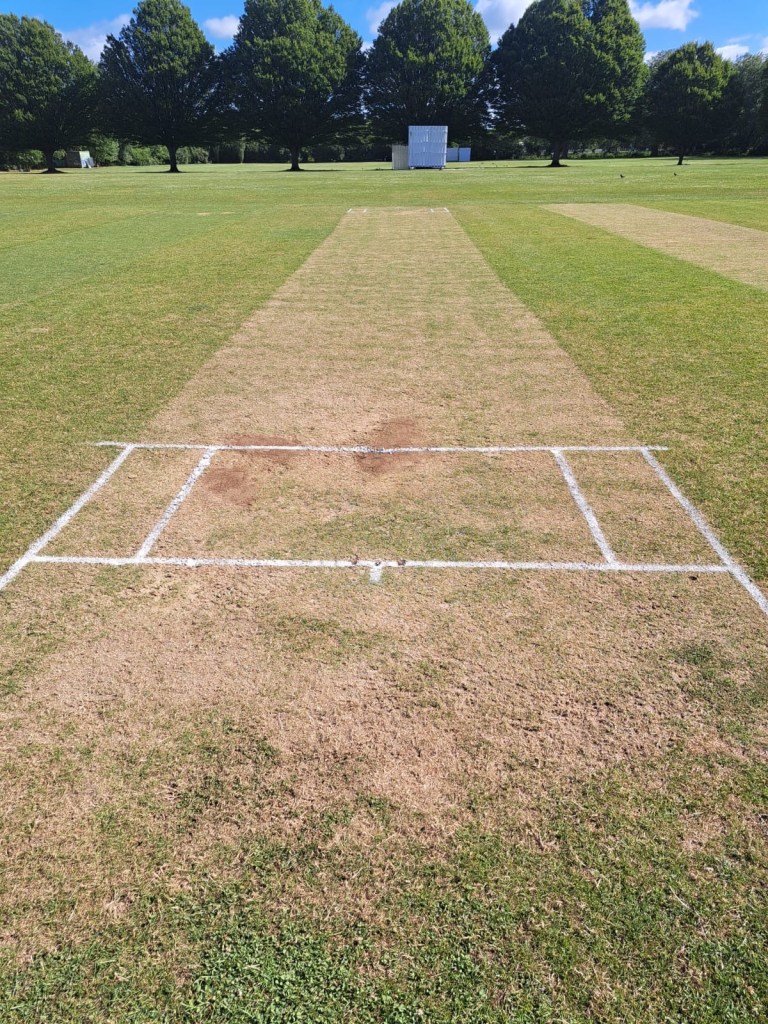
RHCH’s total was 108. Six RHCH batsmen scored no more than one run each, and two of them only managed five. Attentive readers may notice a discrepancy. It is explained by the unfortunate combination of an unreliable bounce and an inexperienced Bard behind the stumps. We gave away sixteen byes and two leg byes (but only two wides). In the drinks break, the Bard replied to a solicitous team-mate’s enquiry that, no, his hands were not sore, despite the best efforts of Rishi and Tom Talks – to which another Racqueteer added, ‘well, to be fair, the ball hardly touched them’. The Bard took this good-natured and affectionate banter on the chin. Which is what would have happened with the match ball if he hadn’t ducked.
Our target, then, was 109. Wykeham Jon (28 not out) and Rishi the ‘Colombo Express’ (25 not out) opened. One might almost have added ‘and closed’, because both looked as if they could have taken us all the way. Jon attracted noisy vocal appreciation for the delicacy – yet penetration – of his cuts, while Rishi showcased not just his usual lofted on-drives but also some judicious defensive work. By the end of the eighth over our score stood at 75 for no loss of wicket, both openers having reached their 25-run limit before retiring. This impressive run rate was partly due to their skilful strokeplayand partly to heavy blood-loss in the medical team’s ‘extras’ department; RHCH haemorrhaged 37 wides in all, despite some valiant and athletic wicketkeeping. (It is perhaps worth pausing over the two instances of ‘6’ having been recorded against ‘wides’ in the scorebook. This apparent mystery is explained by the two-run penalty for a wide in this 20-over format, with the possibility of scoring four further runs if the ball carries to the boundary. Ordinarily you cannot score a sixunless the bat or glove makes contact with the ball, and the rare wide that goes to the boundary without bouncing scores five wides. But you all knew that…)
From the ninth over, the RHCH pace attack found a way to staunch the losses. The extras and the run rate slowed. They were helped, too, by that wayward bounce. But the Skipper and Leo knew what they were about, and patiently let our total mount without throwing away their wickets, so that we reached our target with 16 balls to spare, and without loss of wicket. This would be cheering in itself. The fact that it also marks the fifth successive win for the Racqueteers, and that this represents a club record, is a matter for actual cheers. Yes, we won by ten wickets. But this was not an easy win, it was a good one against an able – and amiable – opposition.
 The Racqueteers Cricket Club