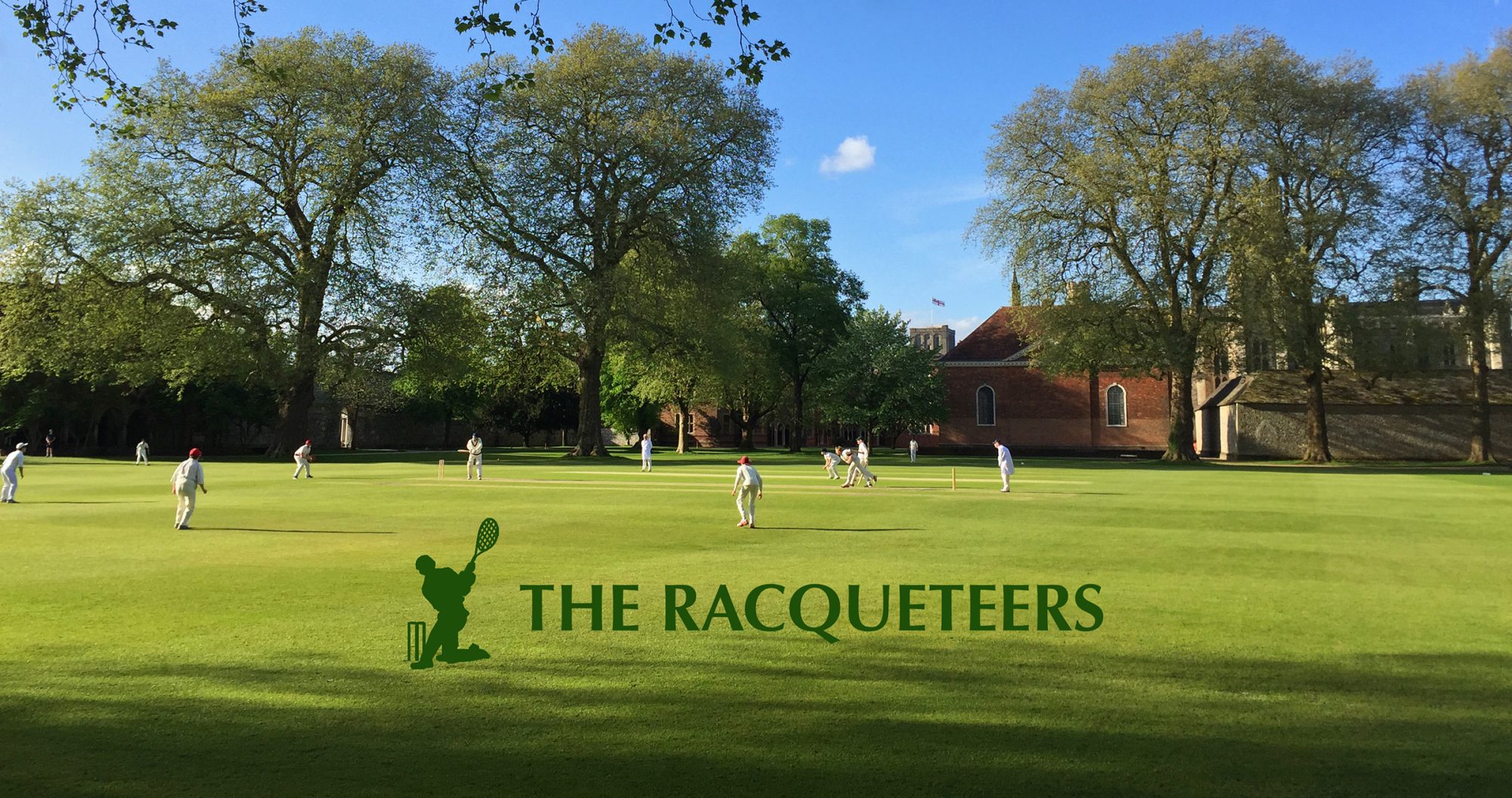
Every batsman arriving at Brown Candover takes in that most deeply ‘village’ of cricket grounds and thinks the same thought. Perhaps his look embraces the patchwork fields stretching in all directions, the rampant English hedgerows, the time-softened thatched cottages, the old church, with its higgledy-piggledy gravestones. Perhaps he hears the cooing of the wood pigeons, the yellowhammer demanding its little-bit-of-bread-and-no-cheese and the pleasant descending wheeze of the greenfinch. Perhaps he regards with approval the meticulously prepared wicket, the well-mown outfield and the pavilion in its elevated setting. He surely considers the long boundary on the downhill side and the shorter one uphill, where a modest net slung between the yew trees half-protects the church — and he thinks to himself, I wonder if I can bounce one off the roof?
The thought of a Big Six was in the minds of all the Racqueteers as we arrived to play the Candover. We were on a record-breaking string of five straight wins. Could we make it one more?
Alas, we did not start well. We bowled first – and bowled well. But a number of lofted balls fell just beyond the reach of an outstretched hand, and the hosts’ opening batsman found the boundary with distressing ease, despite a truculent wicket that had responded to a week under the covers with what theCandovers later admitted was a ‘two-speed’ setting. Some deliveries reared up fast and hard. Others languorously invited the mistimed shot – and the (elusive) catch.
And then: disaster. In the second ball of his spell, the President fell to the ground in his delivery stride, the unlucky victim of a bad muscle strain. The Candovers kindly laid on an ambulance, in the form of a spectator’s 4×4, which ferried him to the pavilion, and Leo bowled the rest of his over. But the opposition seemed to have scented blood, and Leo was uncharacteristically hit for two consecutive sixes over midwicket – and over that long, downhill boundary, as well.Those sixes were shots worthy of a Goliath, and by the end of the third over, our hosts were on 29 for no loss.
Enter David, with a stone and slingshot. David B, that is, witha cricket ball, bowling right-arm over. He struck once in each of his first three overs and twice in his last – a double-wicket maiden! – ending with superb figures (5 for 13). Two of his wickets were good catches, and three were deliveries that perfectly clipped the very top of the stumps. Tom Talks (1 for 12) and Owen (1 for 13) kept things battened down in the middle phase of the game, bowling with pace, penetration and, above all, economy. G, meanwhile, kept a tight grip on things behind the stumps. In all, our extras amounted to ten runs, with just three wides, one no-ball, one leg bye and five byes – which, on that two-speed wicket, was a realachievement. With three overs to go, the Candovers realised they had to post some quick runs but, despite one expensive over, the Bard (0 for 17) and Flipper (0 for 6) managed to wrestle back a measure of control.
Our target was 109 to win. If our stint in the field had started badly, the opposite was true of our time at the crease. Enter another David: Dave F (19). And Alex (30), who admittedly wasn’t up against the Philistines in the original story but probably should have been. These are two classy batsmen. They are very much not sloggers but when they hit it, all the same, it stays hit. It was surely not just the Bard who enjoyed the sight of the Candovers’ cricketers poking about for the ball in their own hedges, for a change. By the halfway point, our openers had posted 63 for no loss of wicket.
And here’s where it took a turn – for the worse, and from the hosts’ spinners. The Candovers claimed Flipper (2) and Jolly (1) and then set out to frustrate Leo (23 not out) and Owen (14 not out). They batted valiantly, and ran whenever possible, but despite their efforts we needed 12 off the final over.
It was a dramatic one. A single. A dot ball. A six! Now we needed four off two… Another single! Last ball… hit well… on its way… but, alas, not to the boundary. They ran one, leaving us one single run short of a tie – and leaving the church roof disappointingly intact.
 The Racqueteers Cricket Club