
You know those children’s stories that get stuck, somehow, in the back of your mind, and then reappear years later, almost as if they’ve been waiting for the right moment? The story that popped into my head, as we toiled our way through a very trying spell in Chilmark’s innings, when ball after ball seemed to rattle across the boundary rope or, just as often, flew right over it, was one about a schoolboy cricket match.
It was from a distressed volume of school stories that must have been handed down from one of my uncles. As I remember it, the chaps of the Lower Fourth had somehow got themselves involved in a challenge match with the men of the First XI. (This, you will have understood, was an old-fashioned public-school yarn.) They didn’t have a hope, of course. The school’s cricket captain was tipped for England, as a likely opening bat, while the top bowler was a bully-boy who wouldn’t slacken off an inch of pace, no matter how small the opposition. But then the bowler made a mistake: he started mocking, taunting and pushing around the younger boys. When the First XI captain found out, he rounded on his team-mate. “Do you know what you’ve done?”, he demanded, with all the indignation of a gentleman-in-the-making. “It’s not just that you’re behaving like a cad; it’s what might happen in the match as a result! You’ve given them iron! Iron in the soul.”
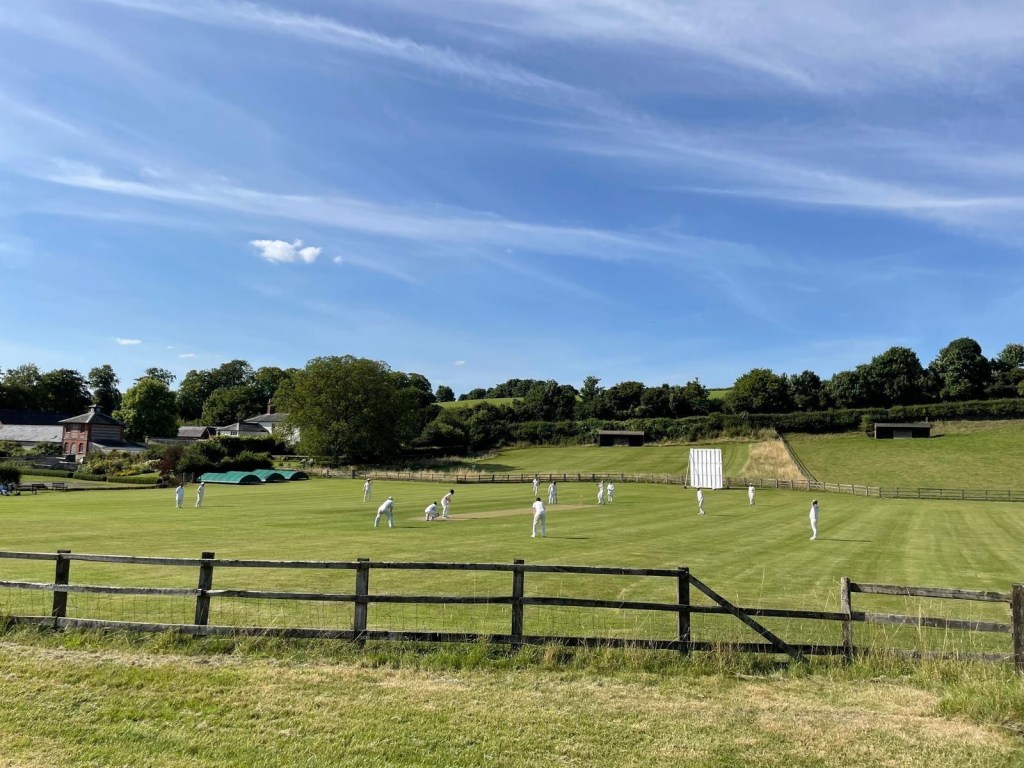
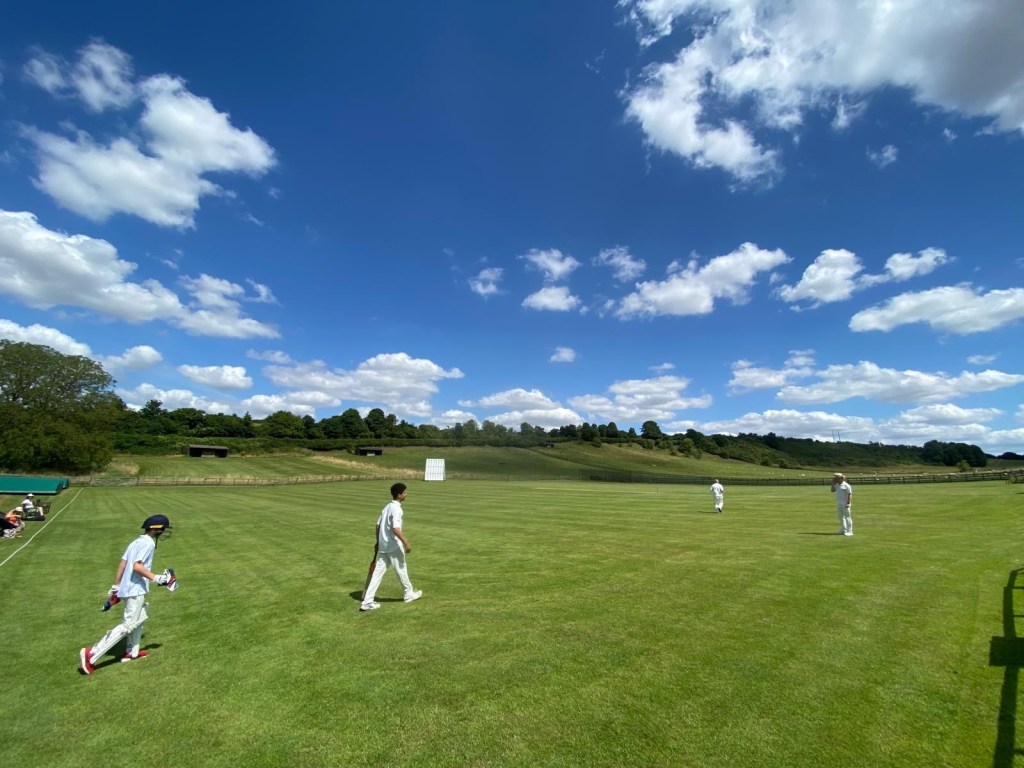
The Racqueteers certainly needed some resolve on that July afternoon. It was the first day of a long-awaited heatwave, and Chilmark positively shimmered. The ground is nestled in a particularly lovely fold of Wiltshire countryside, with a manor house and walled garden on one side, and nothing much but sheep and sky on the other. Sheep and plentiful wildlife, that is: there were swallows and martins darting over the square when we arrived. Later, a yellowhammer started calling for its little bit of bread. Later still, a peregrine passed by, as well as a buzzard with something red and visibly bleeding in its claws.
Was it an omen? We started positively enough. Chilmark were obliged to watch both Dave B (1 for 7) and Sepia (0 for 24) closely – the former looking for the edge with his shapely variations, the latter deceiving with his always-tricky left-arm orthodox flight and tweak. At the eight over, Chilmark had reached 34 for 1. Team Talks, father and son, had some success too: Tom (0 for 25) forcing noticeable stutterings in the otherwise steadily accelerating run rate, and Head of Trout (2 for 45), taking the wickets of their opener and no.5 bat. The former wicket was particularly satisfying: having been hammered for 6 off his first ball, HoT then produced first a dot and then a classic wobbler, clean bowling his adversary with his third delivery.
Other batsman have learned never to underestimate Head of Trout. Our problems came later – when Chilmark’s W. Packer and “Rocket” began to get settled. Both are quality batsmen, and by the time they had started playing their big shots freely, we had rather run out of similar-quality bowling. Charlie (0 for 39), the Bard (0 for 35) and Jules (0 for 44) are unlikely to look back on their short spells with affection; it is hard to bowl at batsmen who seem to have achieved a flow state, but we needed to find more self-belief and nerve than we managed. Ed (1 for 32), who is an honorary Talks, should feel differently. Even if he too was clattered about a little, he claimed an excellent wicket on his first outing for the Racqueteers – bowling the aforementioned W. Packer when he was on 97. Well done, Ed.
Our wicketkeeper, too, had every reason to be proud. Casper, wearing the gloves for the first time for us, kept wicket with skill, resilience and remarkable concentration. One of the Chilmark spectators said he thought it was the best wicket-keeping he’d seen by a young man of that age. His father, Olly, deserves honourable mention, too. Fielding at midwicket, he dived forward, arms outstretched for a desperately difficult catch – the face-first dive is always the one that requires the most commitment. Unfortunately, he hurt his hand and had to retire.
What none of us could do much about, though, was “Rocket”. His score of 128 not out played a significant part in setting Chilmark’s intimidating total of 302 for 6. And chasing 300 in 35 or 36 overs seemed, to be honest, implausible; as a Chilmark regular admitted, even 250 is generally a winning score on their wicket. And the Chilmark bowling attack is perhaps as good as we’ve faced all season – notably the young, ponytailed woman who drops it on the proverbial playing card with pace and deceptive outswing: her name is D. Packer (daughter of the aforementioned W.), and she is said to play for the Surrey under-14s, and we should probably remember her name.
Maybe the opposition thought they had us beat. But they still had to get us out – and there, finally, they floundered. After Deep (1) fell early, Tom Talks (87 not out) and the Bard (13) defended their wickets until the 19th over – the Bard holding down one end while Tom played like a lion at the other. Tom’s technique was irreproachable, and his punishment of the more playable balls unstinting. His innings was frankly superb, and it is only a pity that we ran out of overs before he made his century.
But to return to the game… When the Bard rashly attempted an actual shot, and was bowled, Mike F. (20) came in. He definitely found some iron. A no.3 iron, perhaps? Whatever it was, it sent the ball to the boundary five times before the Skipper finally edged one. But by then we had reached the 29thover, and Sepia (9 not out) and Tom Talks calmly and confidently steered us to the close.
Some complaints, it must be admitted, were overheard in the later stages of our innings. “Do you remember when Sunday teams used to play for a draw like this?”, someone from the Chilmark side muttered within earshot of our square-leg umpire. “We don’t normally play this format”, another one said, “and now I see why.” At that, the Racqueteers umpire may have broken his usual impartial silence to offer the mildest of retorts: “if you had wanted us to play to win”, he demurred, “then perhaps you should not have scored quite so many runs…” What he should have said was this: “if you wanted to win, you should have bowled us out.” As Dolores Ibárruri Gómez said at the Siege of Madrid, “No pasarán!”
Tempting as it is to leave the last word to a communist leaderof the Spanish Civil War, the last – and best words – on the game should come from the gentlemen of our team: Sepia and our captain. On the Racqueteers’ WhatsApp group, Sepia said he was “especially proud of the way we held together and stayed upbeat in the field, on a very warm afternoon, in the face of some brutal hitting during the post-drinks onslaught.” To which the Skipper replied, simply, “Very proud of the team.”
We’re all proud. If we didn’t quite pull off the magnificent achievement of the Lower Fourth (spoiler alert: they won), we kept our chins up and left the field with our heads high.
 The Racqueteers Cricket Club