
The neurophysiology of reward, and the role of delayed gratification, is the subject of intense scientific investigation these days. Why do we pursue certain activities with such passionate dedication, even when – or perhaps partly because – they so regularly disappoint us? Why are particular sounds and movements so uniquely satisfying? Why does it feel so good when we’re made to wait?
Writers have known about delayed gratification for years. It’s why you might start a match report with a plodding sort of sentence that surprises with its barely discernible relevance to the subject at hand. The reader suspects that something better is coming. Something surprising, perhaps. Something, even, about cricket?
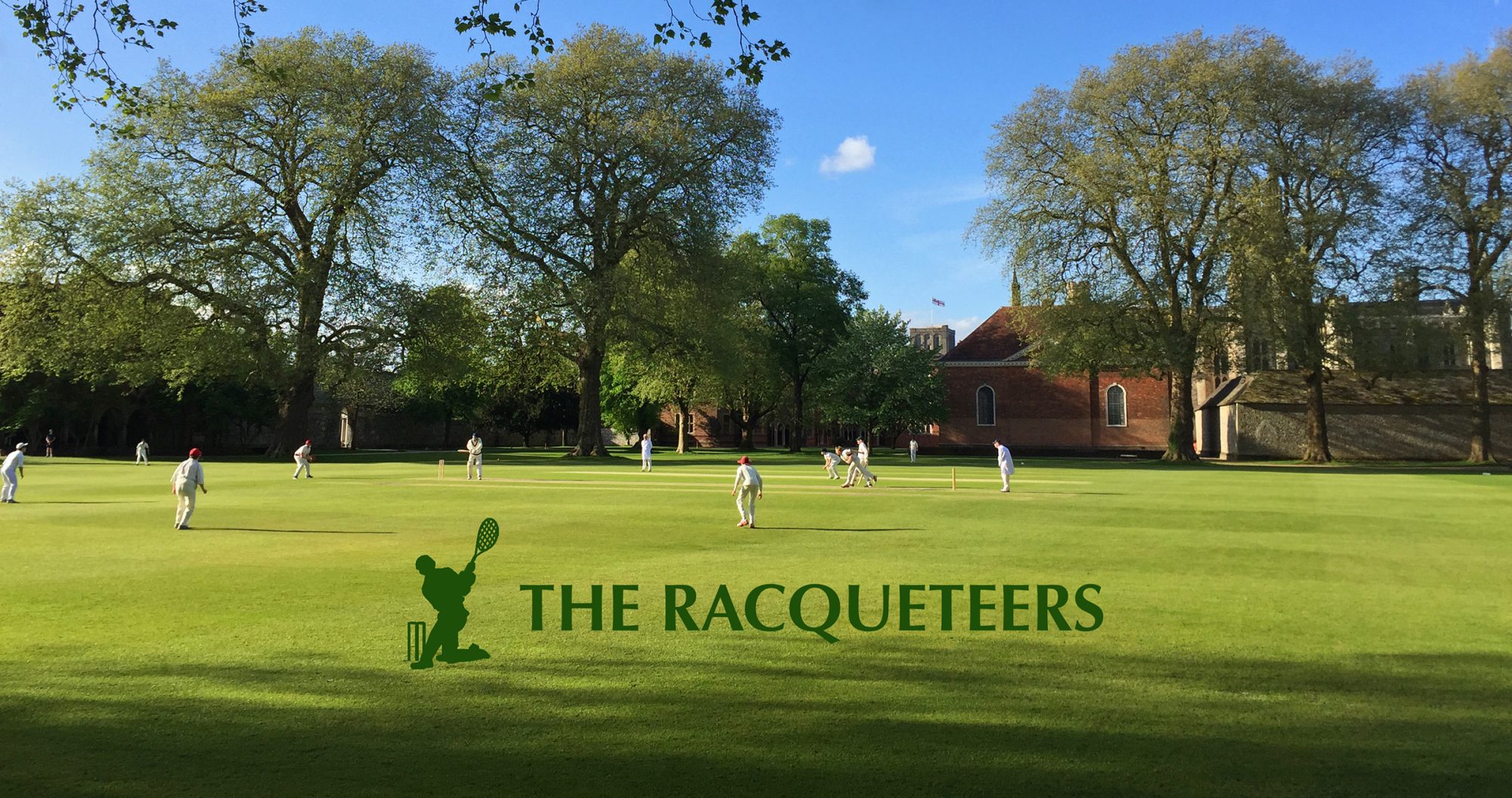
The Racqueteers took to the field on a perfect high-summer day. Perfect, in part, because we have been made to wait right through May, June and half of July for such a day to arrive. And waiting, as we know, makes all the difference. The wicket, admittedly, lacked a little pep, but the skies were blue, the clouds white, the trees green – very green, after all that rain – and a soft breeze played upon the cheek.
Arbour XI batted first. Or, rather, the Racqueteers bowled first – because there was not a great deal of bat on ball, such was the quality of our attack. OC (2 for 11) opened at the north end, with Rishi (3 for 0) flying in from the town. Those statistics are frighteningly good, and are a fair representation of the reality. OC was quick and consistent, finding movement through the air and off the seam. He also took a dramatic caught-and-bowled, diving to remove one of the openers and, simultaneously, half the skin off his arm. (‘They do come in long sleeves’, the Skipper was heard to say, consolingly. Ruefully, OC unrolled the sleeves of his long-sleeved Racqueteers’ top.) As for Rishi, he was heard to claim to be ‘tired’ before the match. He should be tired more often. He bowled with pace, consistency and intelligence. All four of his overs were maidens – two of them wicket maidens. One in-swinging near-yorker of his was simply unplayable.
This was exemplary fast-medium bowling, and OC and Rishi removed all the danger men on the Arbour XI side – and this is a team that typically contains some good batting. It was left to Leo (1 for 14) and Paddy (1 for 16) to clean out the middle order. Leo removed the bails with what looked and sounded like the very seam of the ball, or possible the whisper of its passing; he was afterwards congratulated on his respect for the condition of the stumps. Our fielding was tight, too. Sepia and OC both made fine run-outs – OC pouncing like a tiger on the ball, when it came his way, and roaring like one too, after his extraordinarily rapid throw clattered the stumps. It was left to Dave B (1 for 3) to finish the job.
If the extras (11 wides) were perhaps generous to Arbour XI, the Racqueteers were not complaining. It meant we had to beat 52, which was enough to give us a game. Yes, the sausages and chips were waiting at the pub. But who would want to rush a game of cricket on such a day? Seemingly not Alex (5), the Bard (20 not out) and Mike F (17 not out) – because by the end of the eighth over we had scored only 13 and that seemingly easy target of 53 suddenly felt a bit concerning. The Arbour XI were fired up from the outset, and their medium-pace openers bowled with impressive consistency. They found some movement, too. Alex, trying to create runs with a bit of much-needed aggression, fell in the sixth over to yet another good delivery.
But we had seen out what seemingly were Arbour XI’s only two quality bowlers, and Mike and the Bard scored more fluidly off the first-change men. Mike F calmly watched the good balls, looked for the singles and struck three irreproachable fours. The Bard, finally remembering that he could move his feet, came down the pitch to hit one over the long-on boundary for what even he would admit was a satisfying six. Is there any sweeter feeling than that moment of pure connection with the ball? When you wait, and wait, defending ball after ball, and then something in you shifts and you decide that it’s time and all that’s left is to watch a dot of leather arcing peacefully through the summer sky.
The neuroscientists think they can explain it. As one laboratory study recently reported, ‘the activity of dopaminergic neurons in the ventral tegmental area increases steadily during the waiting period’. As so often, that finding is actually followed by the two dreaded qualifying words: IN MICE. I think the evidence now strongly suggests, however, that we can add three new words: AND IN CRICKETERS.
The waiting over, and the 53 runs finally achieved – in just 12 overs, in the end – the Racqueteers claimed their own reward: sausages and chips at the Alfie. And the feeling of having banked six victories in the last seven matches.
 The Racqueteers Cricket Club
You must be logged in to post a comment.